

Media


Spring Energized Seal Is Not Just a Seal: It’s a Force-Control System
Introduction: Why Most Engineers Misunderstand Spring Energized Seals
When engineers think about sealing solutions, they often categorize them as simple components: O-rings, lip seals, or mechanical seals.
But spring energized seals are fundamentally different.
They are not just passive sealing elements.
They are active force-management systems designed to maintain sealing integrity under continuously changing conditions.
If you treat them like traditional seals, you will underutilize their real value and potentially design an unstable system.
What Is a Spring Energized Seal—Really?
At a basic level, a spring energized seal consists of:
- A high-performance polymer jacket (typically PTFE)
- A corrosion-resistant metal spring energizer
- A precision-engineered sealing lip
As explained in Parjet’s application guide, the spring provides the energizing force that drives the sealing performance, not just the material itself.
More importantly:
- The seal does not rely on material elasticity alone
- It relies on controlled mechanical force generated by the spring
This is the key shift in understanding.
From “Seal” to “Force-Control System”
Traditional seals (like rubber O-rings) depend on:
- Compression set
- Material resilience
- Static deformation
But spring energized seals introduce something different:
1. Continuous Radial Load Control
The internal spring applies a constant, predictable force against the sealing surface.
This ensures:
- Stable sealing under pressure fluctuations
- Compensation for wear over time
- Reliable sealing even at low pressure
Unlike elastomers, which lose force due to creep or temperature, the spring maintains consistent contact stress.
2. Dynamic Adaptation to System Changes
Spring energized seals actively respond to:
- Pressure variations
- Thermal expansion
- Shaft misalignment
- Surface wear
This transforms the seal from a passive barrier into a self-adjusting interface.
In dynamic systems (rotary, reciprocating), this is critical because sealing conditions are never static.
3. Decoupling Material Limits from Sealing Performance
In conventional seals:
Material = Performance limit
But in spring energized seals:
Spring force + material = performance system
This means:
- PTFE provides chemical resistance and low friction
- Spring provides sealing force and recovery
The result is a system that can operate in:
- Extreme temperatures
- High pressure environments
- Aggressive chemical exposure
Why This Matters: Engineering-Level Impact
Thinking in terms of “force control” instead of “sealing” unlocks better system design decisions.
Better Leakage Control
The spring maintains sealing force even when:
- Pressure drops to near zero
- Surfaces wear or deform
This prevents micro-leakage—a common failure in traditional seals.
Longer Service Life
Because the sealing force is actively maintained:
- Wear is compensated
- Contact pressure stays optimized
- Seal failure is delayed
This directly reduces maintenance cycles.
System Stability (Not Just Sealing)
In high-end applications (aerospace, semiconductor, energy), instability is often caused by:
- Fluctuating friction
- Inconsistent sealing force
- Thermal cycling
Spring energized seals stabilize these variables by maintaining controlled contact mechanics.
Where Traditional Seals Fail—and Spring Energized Seals Win
Traditional elastomer seals struggle with:
- Extreme temperature ranges
- Chemical attack
- Pressure cycling
- Low friction requirements
Spring energized seals are specifically designed to solve these problems.
Typical applications include:
- Oil & Gas systems
- Aerospace components
- Chemical processing equipment
- High-precision instrumentation
Introducing HiPerSeal®: A True Force-Control Sealing Solution
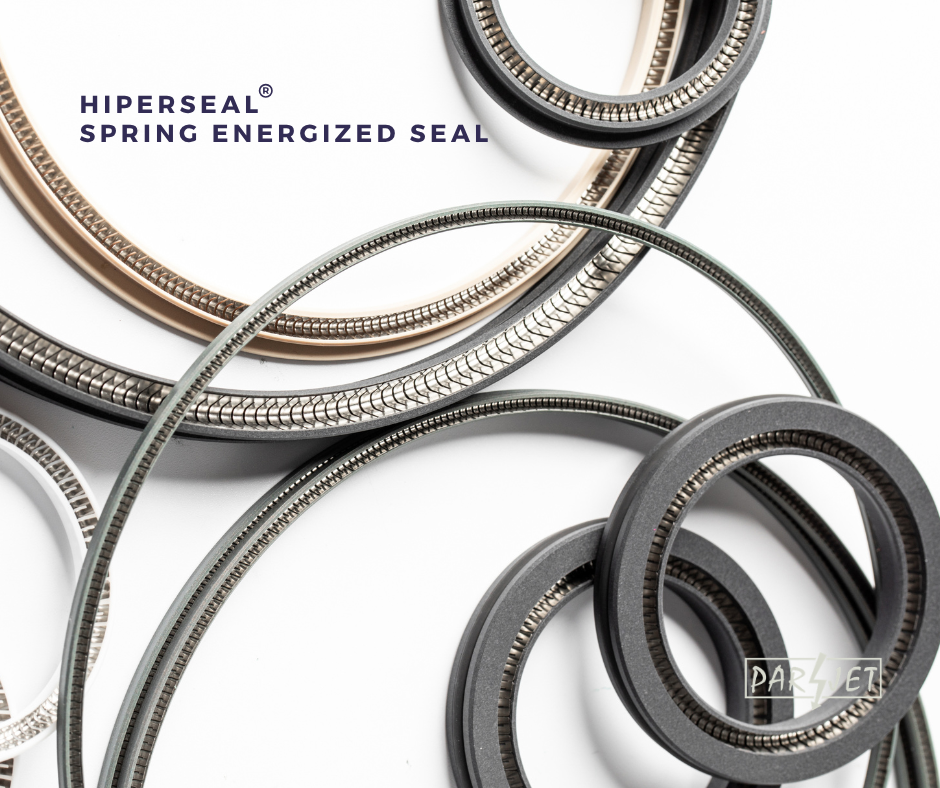
At Parjet, spring energized seals are engineered under the HiPerSeal® series—designed not just as seals, but as precision force-control components.
HiPerSeal® solutions offer:
- Optimized spring geometries (cantilever, helical, canted coil)
- Advanced PTFE-based materials for extreme environments
- Custom-engineered force profiles based on application needs
This allows engineers to:
- Precisely control sealing force
- Match system dynamics
- Extend equipment lifespan
Key Takeaway: Stop Thinking “Seal”—Start Thinking “System”
If you remember one thing:
A spring energized seal is not just sealing fluid—it is controlling force at an interface.
That shift changes everything:
- From component selection → to system design
- From leak prevention → to performance optimization
- From material limits → to engineered force behavior
Design with Force, Not Just Materials
If your application involves:
- Extreme temperatures or pressure
- Chemical exposure
- Dynamic motion (rotary / reciprocating)
- High reliability requirements
Then it’s time to move beyond traditional sealing concepts.
Explore how Hiperseal® from Parjet can be engineered as a force-control solution tailored to your system, not just a replacement seal.