
Media


Piston Seals and Rod Seals: The Short Answer
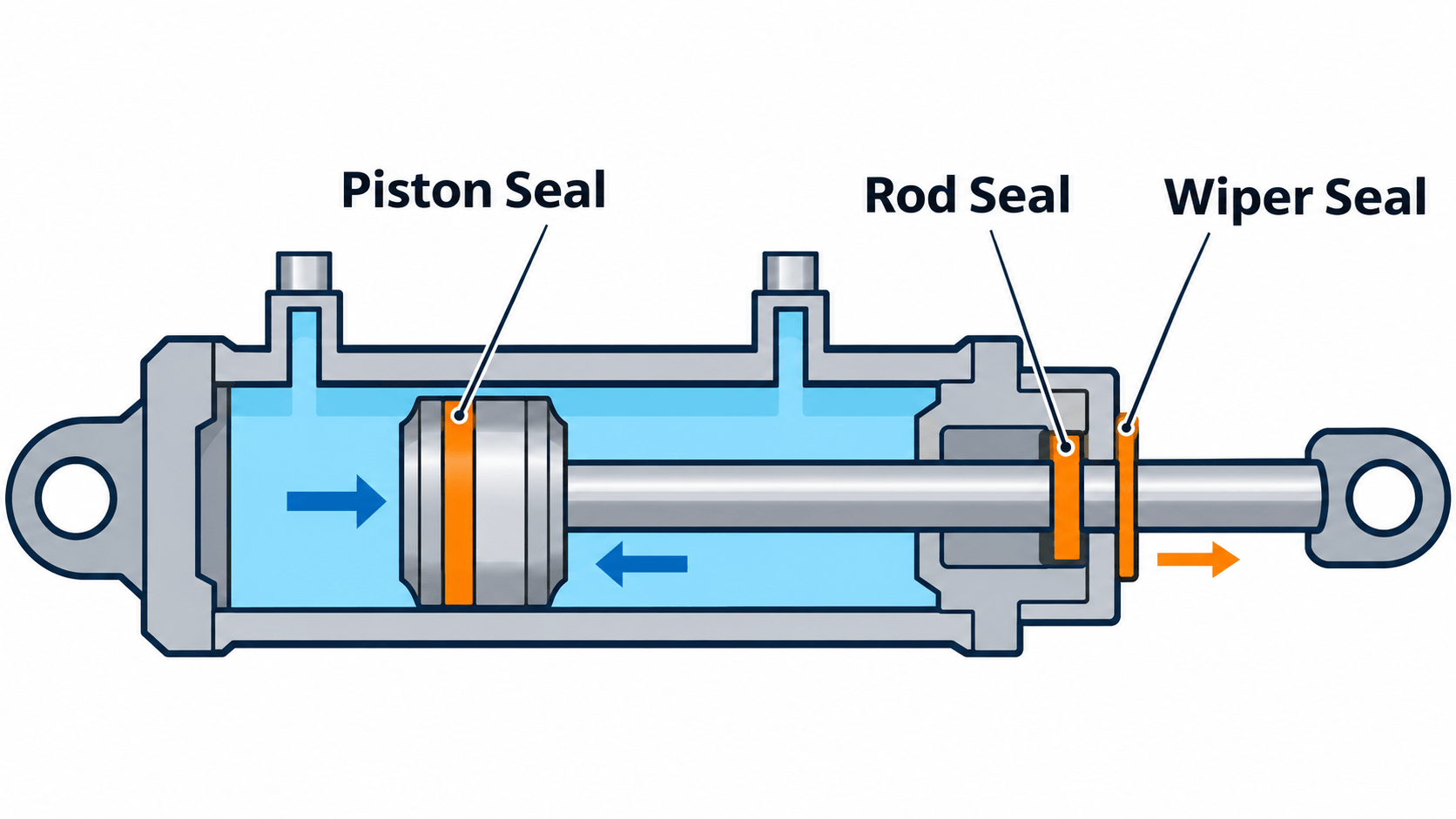
Piston seals and rod seals work together inside a hydraulic cylinder, but they solve different leakage problems. The piston seal is installed on the piston and controls internal leakage between the cylinder’s pressure chambers. The rod seal is installed in the gland and prevents hydraulic fluid from escaping where the rod exits the cylinder.
Most hydraulic cylinders need both. The choice is therefore not “rod seal or piston seal,” but which seal has failed, what duty each position must handle, and which profile and material fit the operating conditions. The wiper is a separate supporting seal that removes dirt and moisture from the rod before it retracts. This article focuses primarily on hydraulic cylinders. The same location-based distinction also applies to many pneumatic cylinders, although materials and operating conditions may differ.
How Do Rod Seals and Piston Seals Differ in Practice?
Purpose and Location
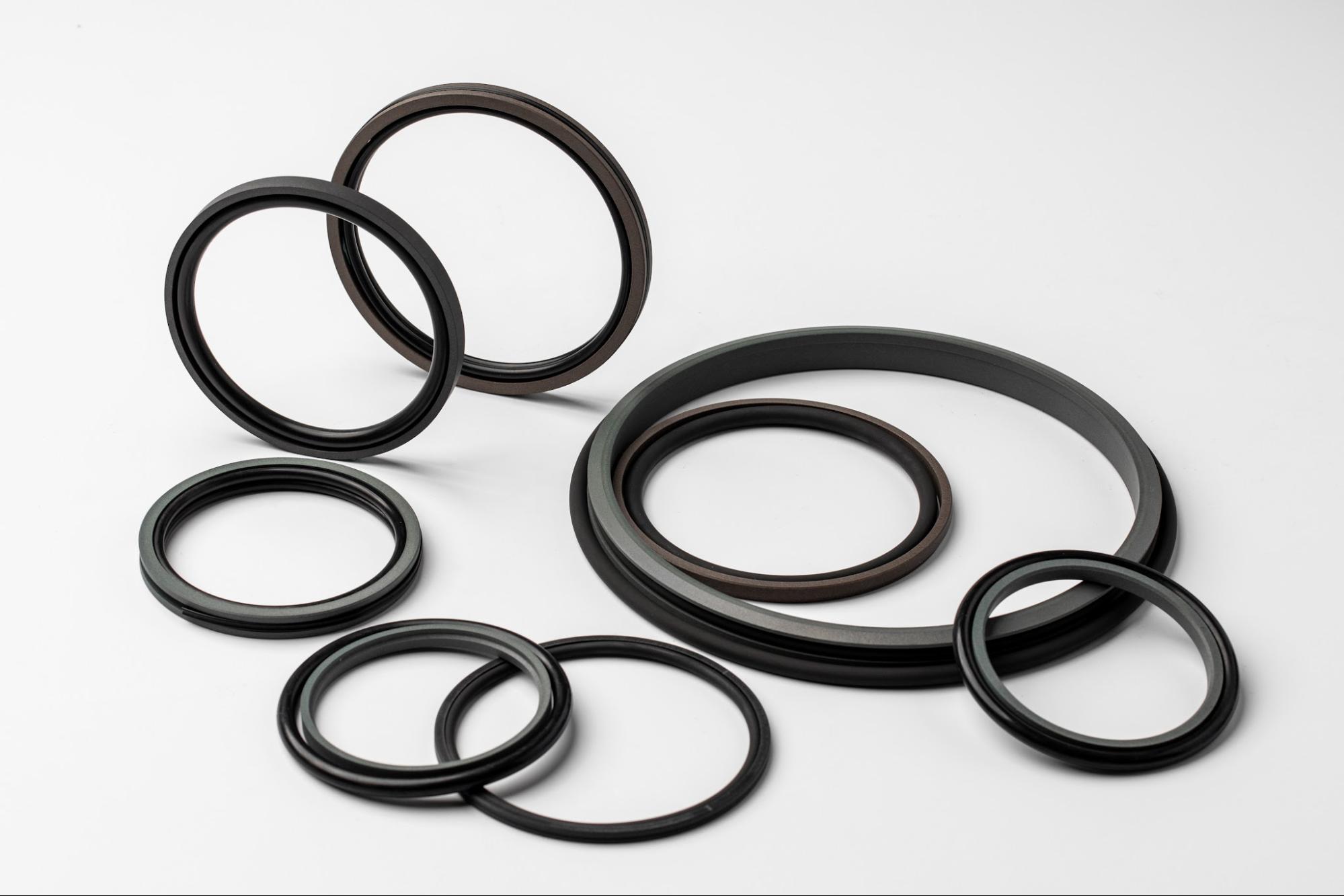
A piston seal sits on the piston inside the cylinder. Its job is to keep pressure from passing too freely between the two sides of the piston. A rod seal sits in the gland where the rod leaves the cylinder. Its job is to keep hydraulic fluid inside while the rod moves in and out.
What the Design Needs to Handle
Because the piston seal works inside the bore, its design focuses on internal pressure separation, movement in both directions where required, friction, and support against extrusion. Because the rod seal works at the cylinder opening, its design must control external leakage and tolerate the rod surface passing through it on every stroke. A wiper sits outside the rod seal and removes dirt and moisture before they enter the gland.
Material Needs
Both positions may use polyurethane, elastomers, or PTFE compounds. The better material depends on pressure, speed, temperature, fluid, surface condition, friction target, and available groove support. The location alone does not determine the material, and a material name by itself does not confirm that the seal profile will fit both positions.
Rod Seal vs Piston Seal: Key Differences at a Glance
|
Feature |
Rod seal |
Piston seal |
|
Location |
Stationary gland; seals against moving rod |
Piston groove; seals against cylinder bore |
|
Main function |
Retain fluid inside cylinder |
Limit bypass between piston chambers |
|
Leakage path |
Toward exterior at rod exit |
Internally across piston |
|
Pressure duty |
Usually cylinder pressure toward exterior; inter-seal pressure may occur |
May reverse across piston in double-acting duty |
|
Contamination exposure |
Exposed rod brings contamination toward wiper and seal |
Mainly contaminants already inside fluid |
|
Typical damage |
Lip wear, scoring-related damage, extrusion |
Wear, extrusion, distortion or twisting |
|
Possible symptoms |
Oil accumulation or dripping near rod exit |
Reduced force, poor positioning, or drift; confirm other causes |
Can the Same Seal Be Used as Both a Rod Seal and a Piston Seal?
Sometimes, but only when the specific profile is designed and approved for both uses. Certain symmetrical U-cups can work in either position under suitable conditions. Many rod and piston seals, however, use different lip shapes, dynamic diameters, or pressure-relief features. Matching the nominal size or appearance is not enough; confirm the drawing, sealing direction, groove dimensions, operating duty, and installation method before substituting one for the other.
When Should You Replace the Seal Kit? Five Signs to Watch
A single symptom does not prove that every seal in the cylinder has failed. However, the following warning signs justify a closer inspection and may indicate that the rod seal, piston seal, wiper, static seals, or guide elements should be replaced as a kit. For a fuller maintenance discussion, read Top 5 Signs Your Hydraulic System Needs a Seal Kit Replacement.
• Visible hydraulic fluid around the rod, gland, fittings, or cylinder body.
• Jerky or uneven cylinder movement, especially during startup or reversal.
• Unusual noise that appears together with unstable motion, air ingress, wear, or poor lubrication.
• A rising operating temperature or repeated heat-related seal degradation.
• Frequent maintenance, recurring leaks, or a seal life that is becoming shorter than expected.
Is It the Rod Seal or the Piston Seal? Where Did the Leakage Come From?
The location of the symptom provides the first clue. Persistent oil around the rod exit directs attention to the rod seal, wiper, rod surface, or gland. A cylinder that drifts, loses force, or positions poorly without visible external leakage may have internal bypass across the piston seal. Neither symptom is conclusive, because valves, worn guides, damaged surfaces, and circuit problems can produce similar behavior.
How to Diagnose the Failed Sealing Position
1. Identify where the symptom appears. Separate external leakage at the rod exit from internal performance problems such as drift or loss of force.
2. Confirm when it happens. Record whether the symptom appears at startup, during reversal, under full load, after warming up, or only after extended cycling.
3. Rule out the circuit and hardware. Inspect the rod, bore, groove, guides, and surface condition, then use the equipment manufacturer’s approved pressure, flow, valve, and cylinder-leakage tests.
4. Inspect the removed components. Photograph the seal before cleaning and look for extrusion, cuts, uneven wear, twisting, chemical change, or incorrect orientation. The damage pattern often shows what must be corrected before a new seal is installed.
A thin lubricating film on a moving rod is different from persistent oil accumulation or dripping. Establish the machine’s acceptable leakage criteria, support the load, isolate energy, and relieve stored pressure before disassembly.
When Should You Start Considering PTFE to Solve Rod and Piston Seal Failures?
Rubber or polyurethane is often the practical first choice when the application benefits from strong elastic recovery, uses a standard groove, and operates inside a well-understood fluid and temperature window. These materials are also easier to install, absorb normal dimensional tolerances well, and can be more economical for higher-volume production.
NBR is a common starting point for compatible mineral-oil service. FKM may suit more demanding fluid or temperature conditions, while polyurethane is frequently selected when abrasion and mechanical wear are major concerns. If the existing rubber seal performs reliably, there may be no engineering reason to replace it with PTFE.
Six Signals That Point Toward a PTFE Review
If your existing rod or piston seals repeatedly fail under any of the following operating conditions, PTFE may be worth considering:
• Temperature extremes: cryogenic service, sustained heat, or wide thermal cycling exceeds the comfortable range of the existing elastomer
• Aggressive media: the seal swells, hardens, contaminates the process, or has uncertain compatibility with the working fluid or cleaning chemicals.
• High speed: the rubber lip overheats or wears too quickly under the required motion or cycle rate.
• Low-friction demand: stick-slip, unstable motion, excessive torque, or power loss affects positioning or equipment performance.
• Poor lubrication: the application involves dry starts, intermittent movement, or limited lubricant at the sealing interface.
• Pressure or extrusion damage: Repeated seal extrusion or wear under high pressure may indicate the limitations of conventional sealing materials. Reinforced PTFE seals offer improved wear and extrusion resistance, providing a more reliable solution when combined with proper seal design.
PTFE becomes especially valuable when a cylinder must reduce friction, resist aggressive media, handle dry starts or limited lubrication, or remain stable across demanding temperature and speed conditions. Filled PTFE compounds can be selected to balance wear, extrusion resistance, dimensional stability, and compatibility with the mating hardware.
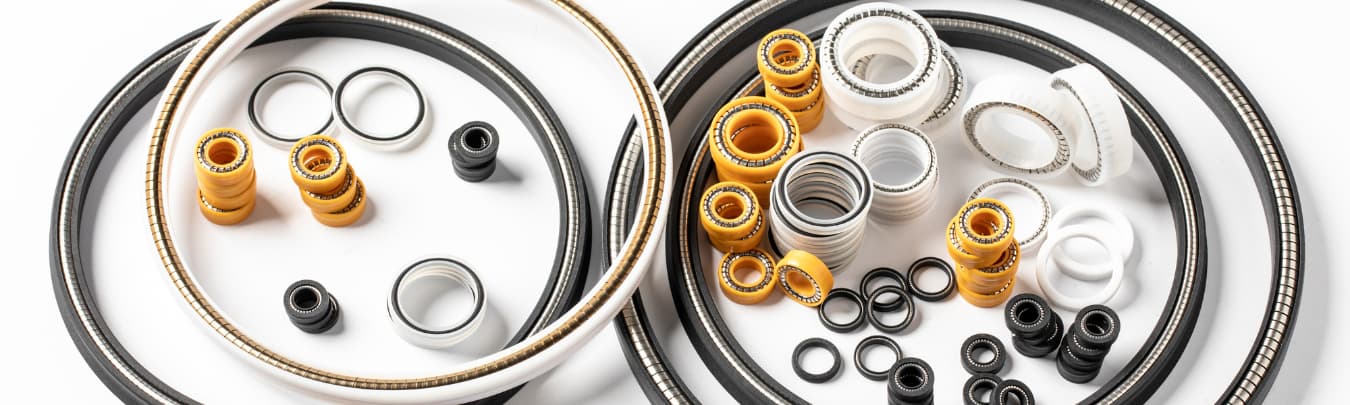
Parjet’s HiPerSeal® spring-energized seals turn those PTFE material advantages into a responsive sealing system. A metal spring maintains lip load as pressure, temperature, wear, or tolerances change, while Parjet can tailor the spring, PTFE compound, profile, and supporting geometry to the application. This is especially useful when a standard elastomer repeatedly fails, a replacement part is obsolete, or the cylinder has a non-standard groove.
Why Engineers Choose Parjet for Rod and Piston Seal Projects

A standard catalog seal is easy to replace when the original design is still working. The harder cases are the ones that keep leaking, wear too quickly, no longer have an available part number, or must fit an existing cylinder that cannot be redesigned. That is where Parjet is different: customers can bring the operating problem to an engineering team instead of trying to choose a seal from dimensions alone.
Application Experience Since 1991
Parjet has worked on sealing applications since 1991, supporting automotive, oil and gas, semiconductor, robotics, and general industrial equipment. That experience helps the team recognize when a failure is caused by the seal material—and when the real issue is the groove, extrusion gap, surface, energizer, or surrounding hardware.
Short lead time and no MOQ
Parjet machines PTFE seals in-house using precision CNC equipment. Because a dedicated mold is not required, customers can request non-standard dimensions, prototypes, small batches, or design revisions without first committing to mold tooling. Parjet also offers short lead times and no minimum order quantity, which is especially useful for urgent replacements, validation samples, and low-volume equipment.
Custom Solution Built Around the Operating Conditions
The discussion starts with the motion, pressure, fluid, temperature, speed, hardware, and failure symptoms. Parjet can then assess whether the application needs a standard glide seal, a spring-energized HiPerSeal® design, a modified profile, or a fully customized solution. Rod-side and piston-side options can be reviewed together so the cylinder is treated as one sealing system rather than two unrelated parts.
Application example: PTFE glide ring in a high-temperature hydraulic cylinder
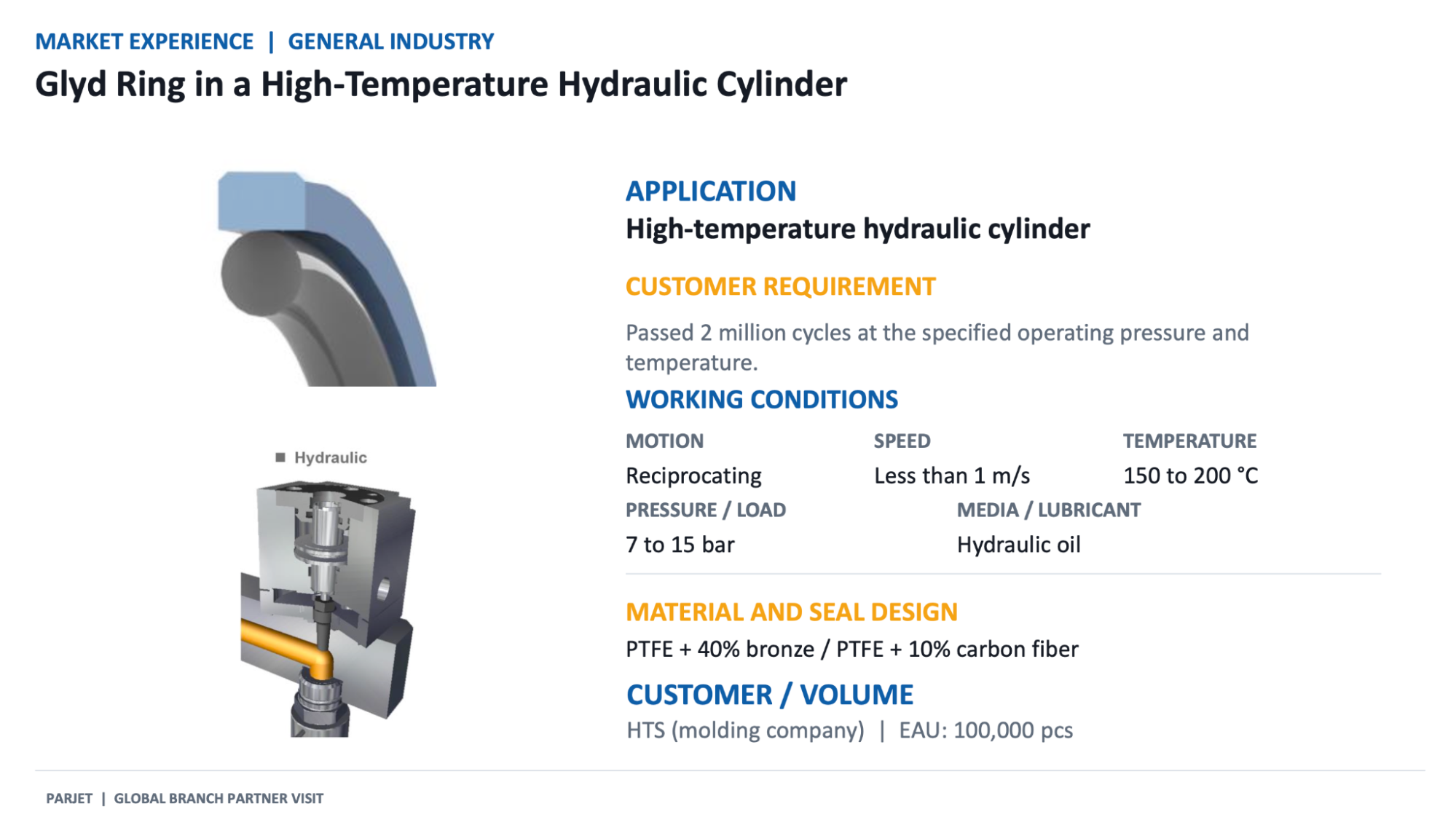
In a high-temperature hydraulic cylinder application operating at 150–200°C, with hydraulic oil and a travel speed below 1 m/s, Parjet developed a customized PTFE glide seal solution using advanced filled-PTFE materials.
The final seal design was successfully validated through 2 million operating cycles under actual test conditions, demonstrating Parjet’s proven expertise in delivering reliable PTFE sealing solutions for demanding industrial applications.
What to send Parjet for a rod or piston seal review
• Drawing and groove dimensions
• Working pressure and pressure spikes
• Hydraulic fluid, process media, and cleaning chemicals
• Operating and startup temperature
• Rod or piston speed, stroke, and cycle rate
• Photos of the failed seal, groove, rod, and bore
• Observed symptoms and when the failure occurs
To explore a solution, review Parjet’s PTFE Glide Seal Set, HiPerSeal® spring-energized seals, and Hydraulic Rubber Seals. Then send the application details through the Contact page. These details help the engineering team distinguish a material problem from a profile, groove, surface, clearance, or system issue.
FAQs
Q1. What is a rod seal?
A rod seal is installed in the cylinder gland where the moving rod exits. It keeps hydraulic fluid inside the cylinder while allowing the rod to reciprocate.
Q2. What is the purpose of a piston seal?
A piston seal controls internal leakage between the pressure chambers on either side of the piston. This helps the cylinder build force and hold position.
Q3. What is the difference between a rod seal and a piston seal?
A rod seal prevents external leakage at the moving rod. A piston seal limits internal bypass between the cylinder’s piston chambers.
Q4. Is a piston and rod the same thing?
No. The piston moves inside the cylinder bore and separates its pressure chambers. The rod connects the piston to the external load and passes through the cylinder gland.
Q5. How do I know if my rod seal or piston seal is leaking?
Persistent oil around the rod exit points toward the rod sealing system. Reduced force, poor positioning, or drift without visible external leakage may indicate piston-seal bypass, although valves and circuit faults should also be checked.
Q6. Should I replace the rod seal, piston seal, and wiper seal at the same time?
Consider a complete kit when the components share age, deterioration, or contamination, or when the service procedure requires it. Inspect the guides, rod, bore, and grooves before installing the new seals.
Q7. Can Parjet make a replacement seal for an existing cylinder groove?
Definitely. Parjet can review the drawing and operating conditions for a custom replacement. Some applications need groove changes or added support rather than a direct-fit substitution.