

Media


Choosing among piston seal types starts with understanding how your hydraulic cylinder works. Which side experiences pressure? How fast does the piston move? What type of fluid does the cylinder use? Answering these questions helps narrow down the piston seal type you need. This article explains what each seal does and how to compare designs and materials to select the right one for your application.
What Does a Piston Seal Do, and Why Does the Type Matter?
A piston seal is a dynamic seal installed on a hydraulic cylinder piston. It creates a sliding barrier that separates fluid pressure on the piston's two sides. By blocking internal fluid bypass across the clearance gap between the piston and the cylinder bore, it lets hydraulic pressure build against the piston face, converting fluid pressure into controlled linear motion and mechanical work.
The seal also rubs against the bore as the piston moves. A proper match between the seal type and the cylinder balances friction, leakage control, wear resistance, and steady motion.
Piston Seals vs. Rod Seals vs. Wiper Seals: Where Each One Fits
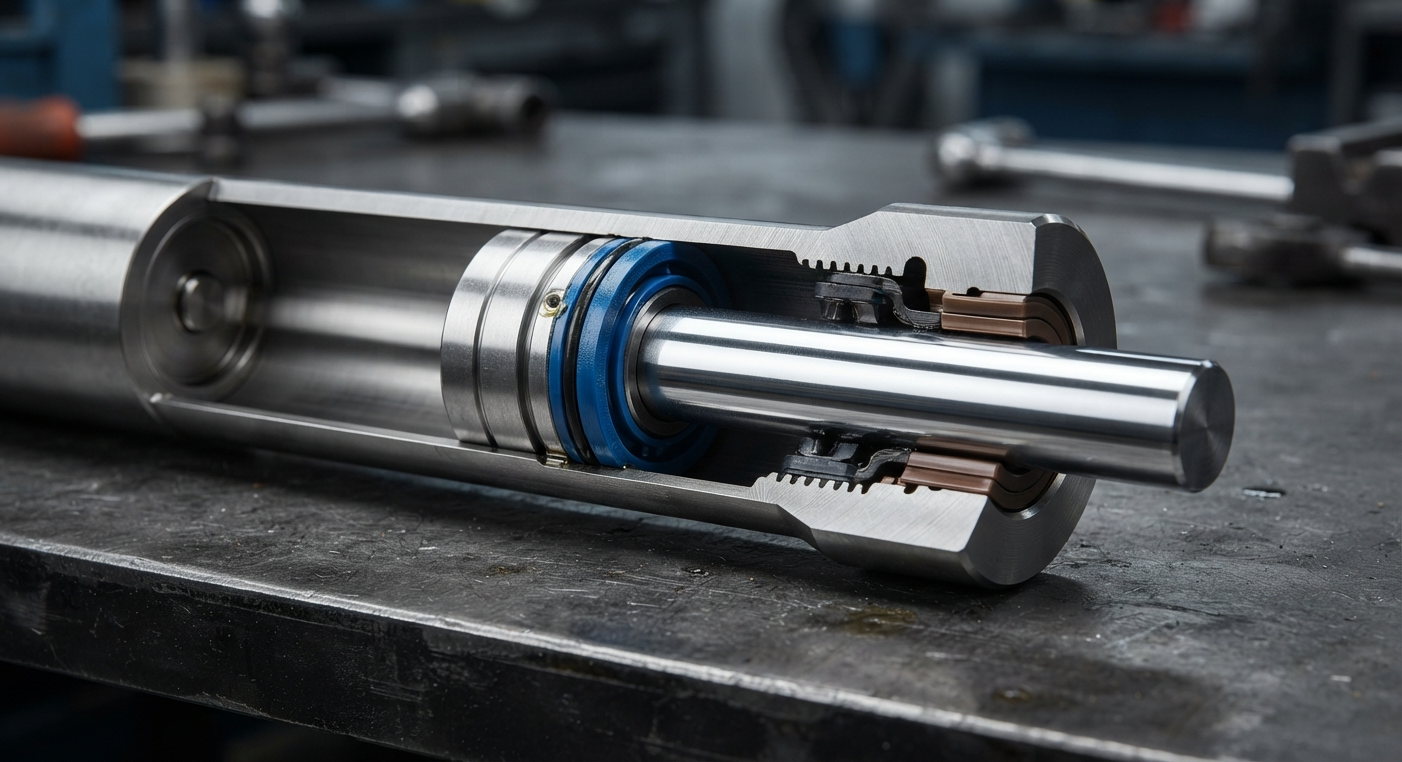
Piston seals block internal leakage inside the cylinder. They move with the piston and keep the two sides at different pressures. Rod seals sit in the cylinder head and wrap around the outside of the moving rod, keeping pressurized fluid from leaking out along the rod.
Wiper seals scrape dirt, dust, moisture, and other debris off the rod surface during retraction. Wear rings keep the piston or rod aligned. They absorb side loads and prevent metal-to-metal contact.
Piston seals, rod seals, wiper seals, and wear rings operate as a single, integrated cylinder sealing system. If oil escapes along the rod, check the rod seal. If the cylinder loses position because fluid passes inside it, check the piston seal and how it fits.
| Feature | Piston Seal | Rod Seal | Wiper Seal |
|---|---|---|---|
| Function | Prevents internal leakage inside the cylinder | Keeps pressurized internal fluid from leaking out | Scrapes external dirt, dust, mud, and moisture off the rod as it retracts |
| Location | In a groove on the piston itself | In an internal groove in the cylinder head | At the outermost edge of the cylinder end cap, facing the environment |
| Typical Failure Modes | Internal fluid bypass, seal extrusion, high compression set | External fluid leakage, abrasive wear, particle scoring | Worn wiping lip, built-up debris passing through, corrosion |
The Three Ways to Classify Piston Seal Types
Piston seals can be grouped by direction of action, structural design, and material. Every seal has all three traits. For example, a double-acting glide ring uses a PTFE ring and an O-ring that pushes it against the bore.
| Classification Method | Core Engineering Focus |
|---|---|
| Direction of Action | Pressure vectors and stroke direction |
| Structural Design | Profile geometry and energizing mechanism |
| Material Composition | Polymer and compound properties |
Method 1: By Direction of Action: Single-Acting vs. Double-Acting
Single-acting piston seals hold pressure from one direction. A double-acting piston seal holds pressure from either side as the cylinder extends and retracts.
| Feature | Single-Acting Seals | Double-Acting Seals |
|---|---|---|
| Pressure Response | Seals pressure from one side only; opposing pressure lifts or unseats the lip. | Seals dynamic and static pressure from both directions continuously. |
| Friction | Lower overall friction, optimized for unidirectional power strokes. | Balanced, consistent friction profile during reciprocating motion. |
| Groove Arrangement | Asymmetrical groove layout; can be paired in separate grooves. | Symmetrical single-groove design incorporating slide rings and energizers. |
| Common Applications | Hydraulic jacks, lifting rams, gravity-return or spring-return cylinders. | Excavators, construction equipment, hydraulic presses, and automated actuators. |
In practice, 2 single-acting seals can be installed back-to-back in separate grooves to create a bidirectional sealing system. However, this configuration carries 2 design risks:
1. Trapped Pressure: Fluid that bypasses the primary lip can become trapped between the two seals, creating severe inter-seal pressure spikes that lead to mechanical binding or seal extrusion.
2. Lubrication Management: Unidirectional lips maintain a microscopic oil film that reduces sliding friction and wear while pumping excess fluid back into the system on the return stroke. In a back-to-back arrangement, this behavior can worsen trapped pressure issues.
Method 2: By Design and What Each Is Best For
The seal shape affects how it presses against the bore and how it handles load.
Lip Seals / U-Cups
Lip seals feature an elastomer or polyurethane lip activated and expanded by system pressure. They are best suited for compact, cost-effective sealing in standard cylinders.
PTFE Glide Rings (O-Ring Energized)
These seals consist of a PTFE ring pressed against the cylinder bore by an O-ring energizer. They suit low-friction applications that require smooth movement without stick-slip in demanding reciprocating systems. Refer to the PTFE glide seal set to learn about its applications.
T-Seals with Backup Rings
These seals consist of a T-shaped elastomeric sealing element supported by backup rings. They provide stable sealing and extrusion resistance at higher pressures.
Spring-Energized Seals (HiPerSeal®)
These seals feature a PTFE jacket energized by a metal spring. They are engineered for conditions that exceed elastomer limits, such as aggressive chemical media, dry running, or strict low-friction requirements. Depending on the application loading, customers can choose from different spring types, including cantilever, helical, and canted coil springs.
Multi-Element / Compact Seal Sets
These sets combine a sealing ring with energizers, anti-extrusion backup rings, and integrated wear guides in a single groove. They are best for heavy-duty cylinders that face extreme shock loads and higher guidance demands.
Comparison of 5 Piston Seal Designs
| Seal Design | Acting Type | Friction Level | Pressure Capability | Typical Use |
|---|---|---|---|---|
| Lip Seals / U-Cups | Mainly single-acting | Moderate to high | Medium to high | Standard cylinders with limited space |
| PTFE Glide Rings | Double-acting | Very low | Medium to high | Fast, repeated strokes and smooth motion |
| T-Seals with Backup Rings | Double-acting | Moderate | High | Stable sealing under higher pressure |
| Spring-Energized Seals (HiPerSeal®) | Single-acting | Low to moderate | Low to very high | Harsh fluids or dry running |
| Multi-Element / Compact Sets | Double-acting | High | Very high | Heavy-duty cylinders |
Method 3: By Material: PTFE Compounds, Elastomers, and Polyurethane
Standard rubber-like materials, including NBR, FKM, and polyurethane, are the practical starting point for seal design because of their natural elastic memory and self-energizing capability. When operating conditions exceed rubber limits, such as temperature extremes, strict low-friction requirements, or rapid rubber wear, engineers turn to PTFE.
While PTFE solves challenging operating conditions, it comes with trade-offs: higher cost, lower elastic recovery, creep, tighter hardware requirements, and greater design sensitivity.
PTFE performance is customized by blending raw resin with specialized fillers such as bronze, carbon, or glass. Fillers determine wear resistance, thermal conductivity, and mating-surface wear characteristics. Therefore, no single PTFE grade suits every application.
| Material | Friction | Wear Resistance | Media Compatibility | Extrusion Resistance |
|---|---|---|---|---|
| NBR (Nitrile) | Moderate to high | Good | Good for mineral oils and fuels; poor for polar solvents | Moderate |
| FKM (Fluorocarbon) | Moderate | Very good | Excellent for aggressive chemicals and fluids | Moderate to good |
| Polyurethane (PU) | Moderate | Outstanding | Good for mineral oils; vulnerable to hydrolysis | Excellent |
| PTFE Compounds | Extremely low | Excellent | Universal (chemically inert) | Excellent |
How to Choose the Right Piston Seal Type for Your Application
To choose the right hydraulic cylinder piston seals, evaluate the cylinder's actual operating conditions using these 4 steps:
Step 1. Establish Sealing Action (Single-Acting vs. Double-Acting)
Determine whether pressure comes from one side or both sides. This indicates which acting type to evaluate.
Step 2. Review Complete Operating Parameters
Evaluate operating pressure and pressure spikes, speed, stroke length, cycle frequency, fluid medium, and operating temperature.
Step 3. Check Hardware and Groove Geometry
Verify groove dimensions and tolerances, extrusion gaps, piston deflection, installation access, and surface finishes.
Step 4. Define the Required Performance Balance
Set performance targets for leakage, friction, wear life, and positioning accuracy. Account for maintenance schedules as well.
If you are unsure which piston seal type fits your application, share your complete operating conditions and technical drawings with Parjet before requesting a recommendation. Parjet's experts can analyze your requirements and propose an optimal sealing solution.
Which Piston Seal Type is Best for a High-Pressure Environment?
No single piston seal type is designed for high-pressure environments because the hardware and operating conditions affect a seal's performance. In high-pressure systems, the hardware's extrusion resistance is critical. This includes the clearance gap between the seal materials and the selected backup components.
Pressure direction can also trap inter-seal pressure if the cylinder configuration lacks proper venting. Additionally, internal fluid pressure causes cylinder barrels to expand radially. If the barrel wall lacks sufficient rigidity, this expansion widens the clearance gap during pressure peaks, risking unexpected seal extrusion.
A system's actual pressure capability can be affected by pressure spikes, temperature extremes, and reciprocating speed. Mechanical side loading or shaft deflection can also deform the hardware and reduce actual pressure capability.
Roles of Common High-Pressure Seal Configurations
• Polyurethane (PU) profiles: Suit high-pressure cylinders with tight clearance gaps.
• PTFE glide rings: Suit high-speed motion and can incorporate firm energizers and hard backup rings for high-pressure service.
• T-seals: Use dual backup rings to resist rolling, twisting, and extrusion.
• Multi-element sets: Combine sealing and guiding elements for cylinders subjected to severe shock loads or heavy side loads.
Parjet's Advice on Piston Seal Selection
Through application engineering, Parjet has observed that seal failures often result from misaligned design choices. Below are common selection mistakes and failure modes:
• Seal Extrusion: When sealing elements show edge damage or extrusion, the typical causes are operating pressure, clearance gaps, material hardness, or pressure direction.
• Internal Leakage: Leakage observed after shutdown or extended periods of inactivity may call for further investigation of thermal cycling, dwell time, restart conditions, seal recovery, and sealing element preload.
• Stick-Slip and Excessive Friction: Jerky cylinder movement or excessive force requirements signal friction-related sealing problems involving motion characteristics, dwell time, lubrication, or mating surface conditions.
• Premature Seal Wear: When piston seals show accelerated wear, it is usually caused by operating pressure, movement speed, lubrication, or mating surface conditions.
• Material Incompatibility: Seals that swell, harden, or degrade require review against operating fluid composition, chemical concentrations, and temperature limits.
• Custom Piston Seal Requirements: When standard seal dimensions cannot meet application requirements, a machined custom seal can be manufactured based on your technical drawing, groove dimensions, required quantity, and delivery schedule.
Follow this 4-step process to select the right piston seal type:
1. Motion Type: Determine whether the application involves a reciprocating rod or piston.
2. Pressure Direction: Identify whether single-acting or double-acting sealing is required.
3. Duty Cycle: Evaluate operating pressure, movement speed, stroke length, and cycle rate.
4. System Conditions: Confirm the operating media, temperature, and hardware surface finishes.
Standard rubber compounds remain an economical starting point for static or light-duty sealing. However, when application demands involve wide thermal cycling, aggressive chemicals, or high pressures combined with high speeds, conventional piston seal materials cannot deliver the required performance levels.
In these conditions, Parjet’s customized piston seal solution is your best alternative.
Based on your application’s temperature, pressure, media, speed, and low-friction demands, Parjet can design a piston seal with a suitable PTFE compound and a custom-designed spring. This ensures the seal delivers the required performance under your specific operating conditions.
When any of these 6 indicators appear in your application, consider upgrading from standard elastomer seals to a PTFE compound. Contact Parjet for technical guidance.
| Application Condition | What to Look For |
|---|---|
| Temperature extremes | Cryogenic service, sustained heat, or wide thermal cycling |
| Aggressive media | Swelling, hardening, contamination, or uncertain compatibility |
| High speed | Rubber lip overheats or wears too quickly |
| Low friction demands | Stick-slip, unstable motion, torque, or power-loss complaints |
| Poor lubrication | Dry start, intermittent motion, or limited lubricant |
| High pressure and extrusion risk | Nibbling, extrusion damage, or large hardware gaps |
Case Study
Parjet’s HiPerSeal® is used in the fingers of humanoid robots. HiPerSeal®, a spring-energized, U-shaped PTFE seal, delivers low-friction performance under high pressure. This allows the robot’s fingers to move smoothly while preventing dust from accumulating inside the robot’s finger joints.
In this application, HiPerSeal® demonstrates superior wear resistance by passing 10 million cycles at a speed of 50 mm/s. Its low-friction characteristic ensures smooth and precise joint movement, operating reliably with hydraulic oil at a maximum pressure of 140 bar.
Why Choose Parjet as Your PTFE Seal Supplier
Parjet can machine custom PTFE spring seals with no minimum order quantity. Using CNC machining processes, we cut seal profiles directly without needing new mold tooling, which is ideal for small orders and non-standard dimensions without adjusting existing grooves.
Parjet's flagship product, HiPerSeal®, uses a spring to press the lips of the PTFE jacket against the sealing surface. As system pressure increases, the sealing force increases, creating a reliable, leak-tight seal.
Advantages of HiPerSeal®
• Manufactured on dedicated CNC machines with no tooling cost, ideal for small-volume or diverse custom PTFE spring seal orders.
• Delivers versatile sealing performance through various spring and seal profile combinations.
• Features a compact design compatible with standard AS568A O-ring grooves
• Can be sterilized in autoclaves or with sterilizing agents.
Parjet's factory is certified to IATF 16949, ISO 9001, and ISO 14001. All custom and standard profiles comply with global dimensional standards, such as AS568A gland dimensions.
If you need an industry professional to advise on piston seal type and specification, send your hardware drawings, operating conditions, and current sealing problems to Parjet via the Contact Us page. Our sealing experts will work with you to identify the ideal sealing solution.
Common FAQs
Q1: Can you customize a piston seal or replace an existing one?
Yes, we can machine replacement seals for existing, worn, or non-standard grooves. Our CNC process produces custom profiles without requiring new molds. For custom piston seals, please share your groove dimensions, hardware drawings, and operating conditions for engineering evaluation.
Q2: What is the difference between single-acting and double-acting piston seals?
A single-acting seal holds pressure from one side. A double-acting seal holds pressure from both sides. Look at which side receives pressure as the cylinder extends and retracts.
Q3: Which piston seal material is suitable for high-pressure hydraulic cylinders?
Hard PU suits many high-pressure cylinders with tight gaps. For more demanding pressure, heat, or speed, consider filled PTFE with hard backup rings. Check the gap at peak load before making a choice.
Q4: When should you use a PTFE piston seal instead of polyurethane or an elastomer?
Consider PTFE when the seal needs lower friction or must handle harsh fluids, extreme temperatures, high speeds, or poor lubrication. The final choice also depends on the grade and the support around the seal.
Q5: Can a PTFE seal replace a rubber seal 1:1?
No, a PTFE seal cannot replace a rubber seal on a 1:1 basis in most applications without engineering modifications. You need to verify the groove dimensions, bore finish, and seal support mechanisms first. PTFE exhibits less elastic recovery than rubber and is subject to creep, so an energizer or backup ring may be required to function properly within the same housing space.
Q6: What information is required to select the correct piston seal?
To select the correct piston seal, evaluate the fluid medium, normal and peak operating temperatures, working and surge pressures, pressure direction, motion type, stroke speed, groove dimensions, and extrusion gaps.
You may also provide the material and finish of the sliding surface, along with your leakage and service-life targets.
Q7: Can Parjet customize a piston seal for an existing cylinder groove?
Yes. Parjet uses CNC turning to precision-shape seals and sealing lips to match your specific groove geometries and hardware tolerances. To order a custom piston seal, please provide your groove dimensions to Parjet for technical review.